

Renting an OBD2 Scanner vs Buying One

October 31, 2026 · 10 min read

Your check engine light is on and you need the code. You can borrow a reader from a parts store, pay for an OBD2 scanner rental, or buy a basic code reader for the glove box. This guide counts the cost in store trips and shows where owning starts to win.
Updated — first published
Quick answer
Buy a basic code reader if you expect more than one check engine light in three years. An OBD2 scanner rental or parts-store loaner refunds your deposit, but one fault usually takes four store trips, about $30 of driving at the IRS rate of 76 cents a mile. Renting wins only for rare jobs that need a professional tool.
The short answer
Buy your own reader if you drive a car you plan to keep, and borrow only for a one-off look. OBD2 (also written OBD-II, the on-board diagnostics system built into every 1996 and newer light-duty car and truck) is the same plug on every car.
The loaner is free in cash terms because you get the deposit back. What it costs you is time and driving, and a single fault usually needs the tool twice: once to read the code and once to confirm the repair worked.
Borrowing is enough if
- Your car is newer and has thrown one light in years
- You are selling the car within a few months
- The job needs a professional scan tool you would use once
Buy one instead if
- Your car is over 10 years old, or you look after more than one
- You have a smog or emissions test coming up
- You want to check the light the day it comes on, not the next time a store is open
How this guide was researched
Every figure here comes from a retailer’s published program terms, a federal agency, or plain arithmetic you can redo with your own numbers.
Sources and method
- Cedar Buy read the AutoZone Loan-A-Tool and O’Reilly Auto Parts Loaner Tool program pages in October 2026, and the EPA’s OBD fact sheet (EPA420-F-02-014).
- Driving cost uses the IRS business standard mileage rate of 76 cents a mile for travel on or after July 1, 2026 (Announcement 2026-11). That rate covers fuel, wear, insurance and depreciation, so it is a full cost of driving, not fuel alone.
- What a basic reader can do is described from the generic diagnostic services in SAE J1979, the standard every OBD2 car must answer.
- No product is named or ranked. Cedar Buy does not physically test products — see our editorial policy.
Where free loaner scanners come from
Free loaners come from the big auto parts chains, and the deal is a refundable deposit, not a rental fee. You pay the tool’s full price up front, use it, and get the money back when you return it in good shape.
AutoZone’s Loan-A-Tool program lets you keep a tool for up to 90 days and return it to any store for a full refund. If you keep it, the deposit becomes the purchase price. One catch: the tool list AutoZone publishes covers pullers, brake, fuel and A/C tools, and it does not name a code reader, so call your store before you drive there.
O’Reilly’s Loaner Tool Program works the same way, with two conditions. You are asked to buy the parts for the job, and the company says tool availability varies from store to store.
Most parts chains will also read your engine codes free at the store, if the car is safe to drive there. A few public libraries lend code readers too, usually for a few weeks.
What a loaner tool will not do
A loaner will not stay with you after the repair, and that is the gap that costs most people a second trip. To prove a fix worked, the car’s readiness monitors (self-tests the engine computer runs while you drive) have to finish, and that typically takes several days of mixed driving.
The loaner shelf also tends to hold engine-only readers. Those read powertrain codes, the ones starting with P. They cannot see the separate computers for ABS brakes, airbags (SRS) or, on many cars, the transmission, so an ABS light stays a mystery.
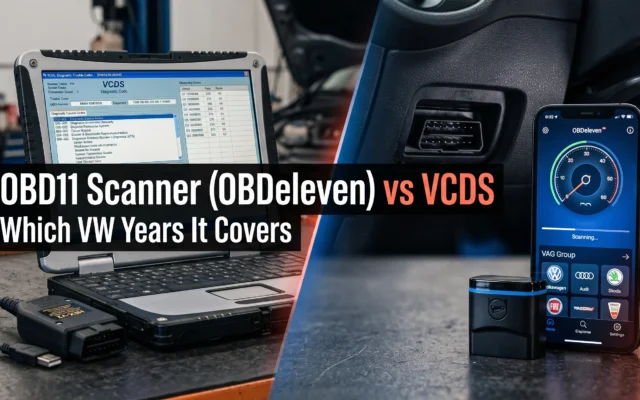
Brand-specific jobs are out of reach too. Battery coding or service resets on some European cars need a tool built for that maker. If you drive a Volkswagen, Audi, Skoda or SEAT, see OBDeleven and VW-specific scanners for what that class of tool adds.
What a loaner costs that is not on the receipt
The deposit sits on your card until you return the tool, up to 90 days at AutoZone, and a missed window turns it into a purchase. Neither is counted in the table below.
Break-even: how many uses
Owning beats borrowing as soon as the driving you save is worth more than the reader. With a 10-mile round trip to the store and four trips per fault, each check engine light costs about $30.40 in driving at the IRS rate of 76 cents a mile.
Hold the fourth column up against a reader’s current price. If the reader costs less, owning is cheaper over three years.
| How often a light comes on | Store trips a year if you borrow | Driving cost a year if you borrow | Owning wins over 3 years if a reader costs less than | Better choice |
|---|---|---|---|---|
| Once every 3 years | About 1.3 | About $10 | $30 | Borrow, or use the free in-store scan |
| Once a year | 4 | About $30 | $91 | Close call: compare the reader’s current price with $91 |
| 3 to 4 times a year | 12 to 16 | $91 to $122 | $274 to $365 | Buy |
| Monthly (two cars, side jobs, smog prep) | 48 | About $365 | $1,094 | Buy, and consider a step-up scan tool |
A 20-mile round trip doubles every dollar figure, and a free in-store scan for the first read cuts four trips to three. Your time is not counted at all.

What an entry-level reader covers
An entry-level code reader covers the engine and emissions side of the car, and that is where most check engine lights come from. It speaks the generic services every OBD2 car must answer, which are defined in the SAE J1979 standard.
Reads and clears engine codes
It shows stored codes (faults the computer has confirmed) and pending codes (faults seen once, not yet confirmed). It can clear them and turn the light off, which is only useful after the fault is fixed.
Shows readiness monitor status
This is the screen an emissions test station checks, and it is why owners in smog-check states get the most from a reader. Before you book a test, see the best OBD2 scanners for smog and emissions checks.
Shows freeze frame and, often, live data
Freeze frame is a snapshot of speed, engine temperature and load at the moment the fault was logged. Many basic readers also show live sensor data.
What to ignore on the box
A long list of supported car brands means little on a basic reader. Every OBD2 car answers the same generic services, so the reader works on any of them. What the box often leaves out is the real limit: no ABS, airbag or transmission codes.
Key terms, explained
These words show up on the reader’s screen with no explanation.
Plain-language definitions
- DTC (diagnostic trouble code)
- A five-character fault code such as P0420. The letter names the system: P for powertrain, B for body, C for chassis and U for network faults.
- MIL (malfunction indicator lamp)
- The official name for the check engine light. A steady light means a fault is stored; a flashing light means a severe misfire, and you should stop driving hard.
- Readiness monitor
- A self-test the engine computer runs on one emissions system, such as the catalytic converter or evaporative system. Clearing codes resets every monitor to “not ready”.
Mistakes that cost people money
The most expensive mistake is clearing codes with a borrowed reader right before an emissions test, because the car then shows “not ready” and gets turned away.
- Clearing codes before a smog testClearing resets every readiness monitor, and most state programs reject a car with too many incomplete ones.
- Borrowing an engine-only reader for an ABS or airbag lightA basic reader cannot see those systems. You make the trip and learn nothing.
- Buying parts on the first codeA code names the symptom, not always the part. P0420 can be a catalytic converter or an oxygen sensor; check freeze frame and live data first.
- Letting the return window lapseMiss it and you have bought a well-used shop tool at full price.
Frequently asked questions
Does AutoZone loan out OBD2 scanners?
Sometimes, but do not count on it. AutoZone’s Loan-A-Tool program works on a refundable deposit with a 90-day return window, yet the tool list it publishes does not name a code reader. Call your store first. If none is available, the free in-store scan still tells you which code is stored.
Is it cheaper to rent or buy an OBD2 scanner?
Buying is cheaper for most owners once a car has more than one check engine light in three years. A parts-store loaner costs nothing in fees, but a typical fault needs four store trips, about $30 of driving on a 10-mile round trip at the IRS rate of 76 cents a mile. Compare that figure with a basic reader’s current price.
Can a borrowed code reader read ABS and airbag codes?
Usually not. Most loaner readers are engine-only and read powertrain codes, the ones starting with P. ABS, airbag and many transmission faults live in separate computers that need a scan tool with those systems listed by name. If your warning light is ABS or SRS, ask the store specifically for a tool that covers it, or plan to buy one.
Will clearing the code let my car pass a smog check?
No. Clearing codes resets the readiness monitors, and most state emissions programs reject a car with too many unfinished monitors. They typically need several days of mixed city and highway driving to complete. Fix the fault, clear the code, drive normally, and check the monitor screen on your reader before you book the test.
When an OBD2 scanner rental genuinely makes sense
Renting makes sense when the tool is expensive, the job is rare, and you will not need the tool again. A paid rental of a full-system scan tool fits a one-off job such as bleeding ABS brakes or resetting an airbag module, which a basic reader cannot do. A free loaner fits a car you are about to sell.
For everyone else, Cedar Buy’s advice is to own a basic reader and keep it in the glove box. Work out your own break-even with the table above, then pick a reader that shows readiness monitors and live data. To see how one well-known maker’s range compares, read Innova scanners compared (2026).

Article engagement
Comments (0)
No comments yet. Be the first to share what you think.
Sign in to join the conversation.