

Car Diagnostic Tools: What Each Tier Buys You

October 25, 2026 · 11 min read

Your check-engine light is on, the shop wants a diagnostic fee, and the tool aisle runs from pocket code readers to tablets that cost as much as a set of tires. A car diagnosis tool is the plug-in device that asks your car’s computers what went wrong. What matters is how far into the car each price tier can see, so you buy enough tool for your job and no more.
Updated — first published
Quick answer
A car diagnosis tool under $30 reads and clears engine (P) codes only. The $30–100 tier adds live data on your phone, the $100–300 tier adds ABS and airbag (SRS) codes, and only $300-plus tools send commands back to the car. For a check-engine light on a 1996-or-newer car, the cheapest tier is enough.
Who this guide is for
This guide is for car owners choosing a scan tool before they spend anything. You do not need to know what a code means yet, only what you want the tool to do.
This is for you if
- A warning light came on and you want the code before you call a shop
- You do your own brakes or batteries and meet lights a basic reader cannot clear
- You are weighing a professional automotive scan tool against a cheaper one and want to know what the extra money buys
Look elsewhere if
- Your car was built before the 1996 model year. It may use OBD1, which none of these tiers read
- You want to reprogram modules with dealer software. That needs the carmaker’s own subscription and interface, not a retail scan tool
How this guide was researched
This guide is built from the standards that define what a scan tool can ask a car, not from product listings.
How this guide was researched
- Cedar Buy read SAE J1979, SAE J2012, ISO 15765-4, EPA’s OBD rules and scan-tool makers’ secure-gateway documentation in October 2026.
- Tiers are judged by which car systems a tool can reach. No products are named or ranked.
- Price bands describe segments of the market, not current listings, and Amazon’s prices change.
- Specifications come from manufacturer documentation. Cedar Buy does not physically test products — see our editorial policy.
The four tiers in one table
Each tier reads everything the tier below it reads, then adds one more layer of the car. The column to watch is “Cannot do”, because that is where people overspend or underspend.
| Tier | Reads | Cannot do | Usual form | Suits |
|---|---|---|---|---|
| Under $30 | Engine (P) codes, freeze frame, readiness. Clears the check-engine light | ABS, airbag, body or network codes. Little or no live data | Corded handheld, small screen | One car, one warning light |
| $30–100 | Adds live engine data and graphs in a phone app | ABS and airbag codes only via a paid app upgrade. No commands | Bluetooth or Wi-Fi dongle plus app | Owners who want to watch sensors |
| $100–300 | Adds ABS (C) and airbag (B) codes, transmission data, and typically service resets | Little or no bidirectional control. No module coding | Handheld or small tablet, color screen | DIY brake, suspension and battery work |
| $300+ | Adds bidirectional tests, relearns, ABS bleeding and coding | Costs more up front. Updates often need a yearly subscription | Tablet with a wireless plug-in module | Serious DIYers, multi-car homes, small shops |
What the table does not show
A tier tells you what a tool usually reads, not what it reads on your car. ABS and airbag coverage is brand-by-brand, so check the maker’s coverage list for your make, model and year.
Under $30: basic code readers
A code reader under $30 reads and clears engine and emissions codes, and that is all. It cannot see your brakes, airbags or body electronics. For a lone check-engine light, that is often all you need.
These tools work because every 1996-and-newer car and light truck sold in the US carries OBD2 (also written OBD-II), the standard self-check system behind the check-engine light. Older cars may use an earlier system; see OBD1 vs OBD2: does your car have it? before you buy anything.
The limit is set by the standard itself. SAE J1979, the rulebook every OBD2 tool follows, covers emission-related data only. Your ABS and airbag computers sit outside it, so a basic reader never asks them anything.
You still get a trouble code such as P0420, freeze frame (engine conditions when the fault set) and readiness monitors (whether the car will pass an emissions test). The trade-off: a code names a symptom, not a failed part.
$30–100: Bluetooth dongles and apps
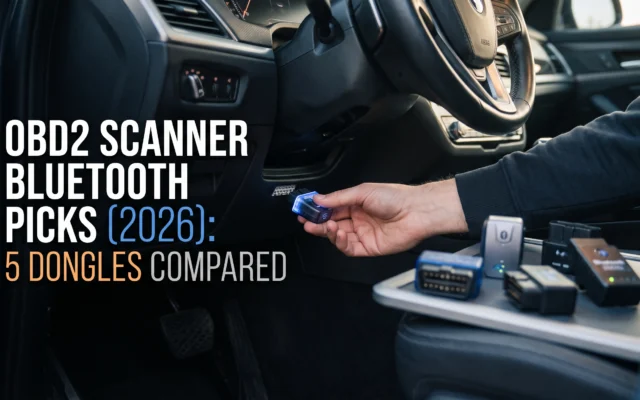
This tier adds live data. A small plug stays in the port and sends engine readings to an app on your phone, so you can watch sensors while you drive. It still cannot command the car to do anything.
Live data is the stream of sensor values the engine computer is using right now, such as coolant temperature in °F or fuel trim in percent. A fuel trim that climbs at idle and settles at speed, for example, often points to a vacuum leak rather than a bad sensor.
The catch is the app. Many dongles are built around the ELM327 command set, a chip design from ELM Electronics, and the app decides what the plug can do. Brand-specific codes, ABS and airbags are often sold as an in-app upgrade or a yearly plan, so the box price is not always the full price.
Get a dongle if you want to watch your engine, not just read it.
$100–300: ABS, SRS and live data
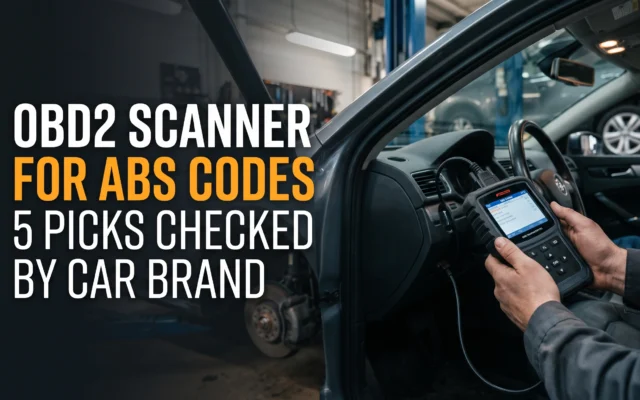
This is the first tier that reads beyond the engine. Tools here typically read ABS (anti-lock brake) codes, SRS (airbag) codes and transmission data, alongside full live data on their own screen.
The ABS and airbag lights are separate from the check-engine light. A basic reader on a car with only an ABS light reports “no codes”, even when a wheel-speed sensor has failed.
Most tools here also handle service functions, the resets that follow a repair: oil-life reset, retracting an electronic parking brake for a rear pad change, and battery registration on cars that need it. Coverage varies by make.
The trade-off is control. These tools mostly listen and rarely let you run the ABS pump to bleed brakes.
$300+: bidirectional and pro tools
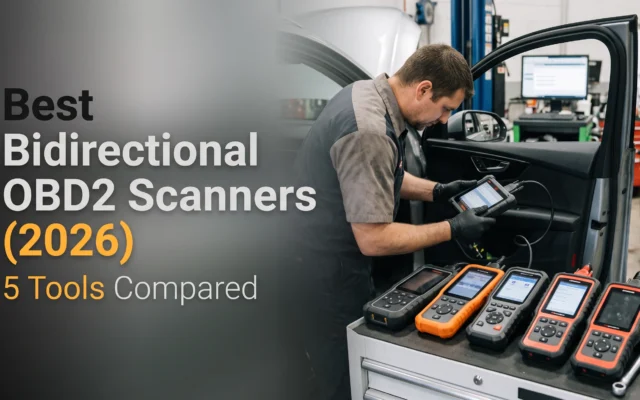
The $300-plus tier talks back. Bidirectional control lets the tool command parts on the car: switch on the fuel pump, cycle the ABS pump, close the EVAP vent, run a throttle relearn. This is the tier sold as professional car diagnostic equipment.
Commanding a part splits a fault in two. If the cooling fan runs when the tool tells it to, the fan and wiring are fine and the problem is upstream.
Newer cars add a gate. On many 2018-and-newer Chrysler, Dodge, Jeep and Ram vehicles, a secure gateway module requires registration and authentication before an aftermarket tool can use certain functions, such as clearing codes or running tests. Only tools approved for that login, and a registered account, get through.
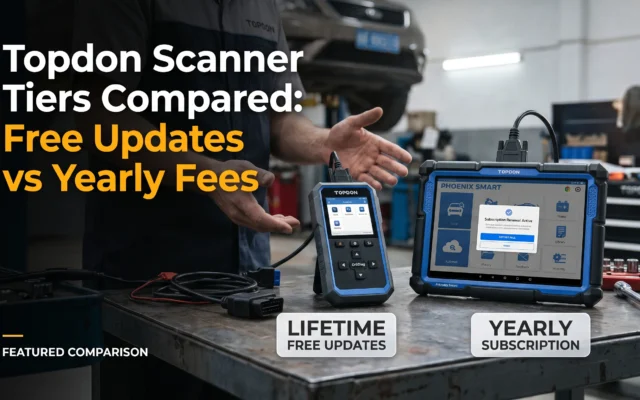
Professional automotive diagnostic tools usually include a period of software updates, then charge for more. Without updates, a tool keeps working on older cars but falls behind on new ones.
Which car diagnosis tool tier fits your use
Match the tier to the job you will actually do, starting with the warning light your car shows.
Which warning light is on
A check-engine light alone needs only the under-$30 tier. An ABS, airbag or traction light needs the $100–300 tier at minimum, because cheaper tools cannot see those computers.
Whether you turn the wrenches yourself
If a shop does the repair, you only need the code to understand the quote. If you replace brakes or batteries yourself, the $100–300 tier’s service resets earn their cost.
Your car’s brand and year
A gateway-locked 2019 Jeep or a car that needs battery registration narrows the field fast. Read the coverage list before the feature list.
The “works on 10,000 vehicles” claim
Ignore it. Every OBD2 tool reads engine codes on every 1996-and-newer car, so a huge number says nothing about ABS, airbag or service coverage on yours.

Key terms, explained
These terms appear on every scan-tool box, and each one hides a limit.
Plain-language definitions
- Diagnostic trouble code (DTC)
- A five-character fault code stored by a car computer, defined in SAE J2012. The first letter names the system: P for powertrain, C for chassis such as ABS, B for body such as airbags, U for network faults.
- Live data
- The sensor readings a car computer is using at this moment, such as engine speed in rpm or coolant temperature in °F. It shows faults forming, not just faults stored.
- Bidirectional control
- A tool’s ability to send commands to the car, such as running the fuel pump. Buyers often confuse it with clearing codes, which every tier can do.
- CAN (ISO 15765-4)
- The wiring language cars use to talk to a scan tool, required on US cars from the 2008 model year. Every current tool supports it, so it is no reason to pay more.
Mistakes that cost people money
The most expensive mistake is buying a code reader for an ABS or airbag light. The tool reports no codes, and the owner pays a shop to read the code anyway.
- Buying for the wrong warning lightCheck which light is on first. Anything other than the check-engine light needs the $100–300 tier or higher.
- Clearing a code and calling it fixedClearing turns the light off and resets readiness monitors. The fault returns if the cause is still there.
- Missing the subscriptionDongle apps and pro tools often charge yearly for features or updates. Add two years of that cost to the box price before comparing.
Frequently asked questions
Can a cheap OBD2 scanner read ABS codes?
No. A basic OBD2 code reader only reads engine and emissions codes, because the generic standard, SAE J1979, covers emission-related data only. ABS codes sit in a separate brake computer. You need a tool that lists ABS support for your make, usually the $100–300 tier.
Is a professional automotive scan tool worth it for a DIY mechanic?
Only if your repairs need the car to be commanded. Bleeding ABS brakes, relearning a throttle body or coding a new module all need bidirectional control. If you mainly read codes and reset service lights, a $100–300 tool does that with no update subscription to renew.
Will clearing a code with a scanner fix the problem?
No. Clearing a code only turns off the light and erases the stored fault. If the cause is still there, the code returns, often within a few drives. Clearing also resets readiness monitors, so the car may fail an emissions test until it has been driven enough to rerun them.
Why can my scanner read codes but not clear them on a 2019 Jeep?
Many 2018-and-newer Chrysler, Dodge, Jeep and Ram vehicles have a secure gateway module. It lets any tool read codes but blocks clearing and tests until the tool logs in through an approved authentication service. You need an approved scan tool and a registered account.
What to do next
Look at your dashboard, then buy the lowest tier that reads the light you see.
A check-engine light alone means an under-$30 reader, or a $30–100 dongle for live data. An ABS, airbag or traction light means $100–300, checked against your make’s coverage list. Step up to $300-plus only for regular repairs that need the car to be commanded.
When the tool arrives, write the code down before you clear anything and follow how to use an OBD2 scanner, step by step. Cedar Buy’s view: the cheapest tool that reaches the right computer beats the priciest one that does not.
Article engagement
Comments (0)
No comments yet. Be the first to share what you think.
Sign in to join the conversation.