

Roof Box vs Roof Bag vs Basket

November 1, 2026 · 10 min read

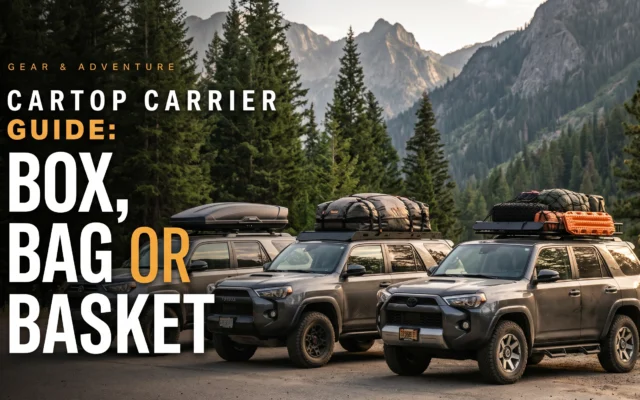
Your trunk is full, the back seat has people in it, and the roof is the only space left. So what goes up there: a hard box that locks, a soft bag that folds away, or an open basket for roof basket cargo like coolers, firewood and spare tires? Each one costs you something different: money, dry gear, or garage space. This guide compares all three on the four things that decide the purchase.
Updated — first published
Quick answer
Buy a hard roof box for locked, dry storage if you can store a 5 to 8 ft shell. Buy a soft roof bag for one or two trips a year: it costs least and folds small. The exception is bulky roof basket cargo like coolers, tires and firewood, where an open basket wins but keeps nothing dry.
Who this guide is for
This guide is for you if you know you need roof space but cannot decide which kind of carrier to buy.
This is for you if
- A road trip is coming and the cargo area is already full
- You have little room at home to store a carrier between trips
- You haul coolers, firewood or a spare tire
Look elsewhere if
- You only carry bikes, kayaks or skis. A dedicated mount holds them better
- You want a hitch-mounted carrier. This guide covers roof carriers only
The one-table answer
No carrier wins every column. The hard box wins security and weather, the soft bag wins cost and home storage, and the basket wins awkward, dirty or oversized loads.
| Carrier | Relative cost | Typical capacity | Weather | Home storage | Lockable |
|---|---|---|---|---|---|
| Hard roof box | Highest of the three | About 11 to 22 cu ft (300 to 620 L); large models rated to 165 lb | Rigid shell, overlapping lid. The driest | 5 to 8 ft long and rigid. Needs a wall or ceiling hoist | Yes, with a key |
| Soft roof bag | Lowest | About 13 to 16 cu ft; often rated to 100 lb | Water-resistant, not waterproof | Folds into a stuff sack | No. Fabric can be cut |
| Roof basket | In between | Open tray, often 46 to 49 in long and 32 to 40 in wide; rated about 110 to 150 lb | None on its own | Flat, about 6 in tall. Leans on a wall | No. Only an added bag can be locked |
What the table does not show
Your car’s roof limit caps all three, and it covers the bars, the carrier and the cargo together. Hyundai’s owner’s manual, for example, lists 165 lb (75 kg), evenly distributed, for one model’s roof basket.
Hard boxes: security and aerodynamics
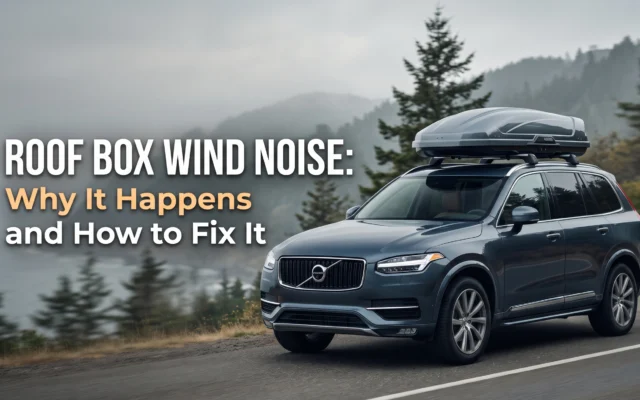
A hard roof box (also called a cargo box or rooftop carrier) is the only one of the three that locks and keeps rain out without help. Its tapered nose lets air flow over it smoothly, which makes it the quietest shape on the roof.
Quiet is not free. The U.S. Department of Energy says a large, blunt roof box can cut fuel economy by 6% to 17% on the highway and 10% to 25% at 65 to 75 mph. In the Oak Ridge National Laboratory tests behind those numbers, a compact sedan lost up to 25% to 27% at higher speeds. No comparable government test exists for bags or baskets.
The keyed lid stops a passer-by in a motel lot, not someone with a pry bar, so keep laptops in the cabin. The trade-offs are cost and weight: a box is the priciest option, and mid-size to large boxes weigh about 33 to 49 lb empty.

Soft bags: cost and storage
A soft roof bag (a rooftop cargo bag) is the cheapest way to add roof space, and the only carrier that folds small enough for a closet. If you take one or two long trips a year, get the bag.
Bags from the major rack makers hold about 13 to 16 cubic feet and weigh about 8 to 10 lb, so more of your roof limit goes to gear. Most strap to crossbars or side rails. Some run through the door frames on a bare roof, but check the instructions first, since some makers forbid it.
You give up a lock and full rain protection. A half-empty bag also flaps and hums, so pack it full and cinch the straps.
Roof basket cargo: odd-shaped loads
A roof basket (also called a cargo basket or roof tray) is right when your load is the wrong shape for a box. Coolers, fuel cans, firewood, a spare tire and muddy tents ride better in an open tray.
A typical basket is a steel or aluminum frame about 46 to 49 inches long and 32 to 40 inches wide, with rails around 6 inches tall. You strap everything down with ratchet straps or a cargo net, and you keep tall loads inside the roof’s length and width.
The costs are noise and weather. Open rails catch the wind, so a basket is usually the loudest of the three, and a front fairing only partly fixes that. The common fix for rain is a soft bag strapped inside the basket.
Weather resistance compared
A hard box is the only carrier that keeps gear dry in steady highway rain without extra steps. A bag slows water down; a basket does not stop it at all.
The best bags carry a rating. Thule rates its top soft bag to IPX3 under IEC 60529, which covers water sprayed at up to 60 degrees from vertical. That is rain on a parked car, not rain forced into zippers at 70 mph. Thule’s own instruction sheet tells you to pack cargo in plastic bags if it rains.
So line any bag with contractor trash bags before a wet drive, and wrap basket loads in a tarp.
Storage space at home
A soft bag takes the least space at home, a basket comes next, and a hard box takes the most. In an apartment, that may decide the purchase.
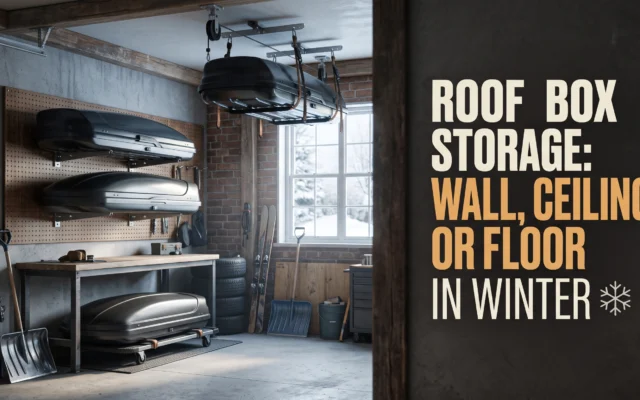
Current hard boxes run from about 5 ft 2 in to 7 ft 9 in long and 25 to 38 in wide. Most owners hang one from the garage ceiling, stand it against a wall, or leave it on the car and pay for that at the pump. A basket leans flat against a wall, and a bag rolls into a stuff sack.
What to check before you buy any of them
Check your crossbars and your roof limit first. Those two numbers rule out more options than any feature.
Your crossbars come first
Crossbars are the bars that run side to side across the roof, and boxes and baskets clamp to them. On a pickup with no rack yet, start with how to install a roof rack on a truck.
The roof limit, minus the hardware
Subtract the bars and the empty carrier from your manual’s roof limit. A box can use 33 to 49 lb of it; a bag about 8 to 10 lb.
Total height against your garage door
Box shells stand 12.5 to 20 in tall before the crossbars. Measure the whole stack before you drive under anything.
Ignore the headline volume
The liters on a box describe the shell, not what fits. A long, shallow box takes skis but may not take a hard suitcase, so check interior height.
Key terms, explained
These terms appear on every spec sheet and are easy to misread.
Plain-language definitions
- Roof load limit
- The most weight a car’s roof may carry while driving, set by the carmaker in the owner’s manual. It includes the bars, the carrier and the cargo.
- Fairing
- A curved panel at the front of a basket or rack that deflects air over the load. It cuts wind noise without making a basket as quiet as a box.
- IPX3
- A rating under IEC 60529 for resisting water sprayed at up to 60 degrees from vertical. It is not a waterproof rating.
Mistakes that cost people money
The costliest mistake is trusting a soft bag to keep clothes dry in a highway rainstorm.
- Treating water-resistant as waterproofLine a bag with trash bags, or buy a box for rainy routes.
- Forgetting the carrier counts toward the limitA 45 lb box on a 150 lb roof leaves about 105 lb, before the bars.
- Driving into the garage with the box onIt can crack the shell and damage the roof. Tape a note to the door opener.
- Leaving an empty carrier on all seasonAn empty box still costs fuel, and an empty bag flaps and wears.
How this guide was researched
Cedar Buy built this guide from government fuel-economy research and manufacturer documentation.
Our research method
- Fuel figures come from fueleconomy.gov and the Oak Ridge National Laboratory study SAE 2014-01-1614, read in November 2026.
- Capacity, weight and size ranges come from published specifications for current boxes, bags and baskets from Thule, Yakima and Inno.
- Cost is shown as a ranking, not in dollars, because prices change constantly.
- Specifications come from manufacturer documentation. Cedar Buy does not physically test products. See our editorial policy.
Frequently asked questions
Is a rooftop cargo bag waterproof?
No, rooftop cargo bags are water-resistant, not waterproof. The better ones are rated IPX3, meaning they resist sprayed water, but rain forced into zippers and seams at highway speed can still get in. Line the bag with heavy plastic bags before a wet drive. A hard roof box is the only one of the three carriers that keeps gear dry without extra steps.
Can you put a cargo bag inside a roof basket?
Yes, and it is the usual way to keep basket loads dry. The basket gives you a solid floor and tie-down points, and the bag adds a rain cover. Strap the bag to the basket frame, not just to itself. The basket, the bag and the cargo together must stay under your car’s roof load limit.
Can I leave a roof box on my car all year?
You can, but it costs you. The U.S. Department of Energy says a large roof box can cut highway fuel economy by 6% to 17%, and it advises removing roof carriers when you are not using them. A box also adds height that can catch on garage doors. If you use it a few times a year, store it on a wall or ceiling hoist.
Which fits your trip
Match the carrier to your next real trip, not every trip you might take. This is Cedar Buy’s editorial opinion.
Long highway drives, ski trips, motel stops: get a hard box. It locks, stays dry and runs quietest at speed.
One or two family trips a year, apartment living: get a soft bag. It costs least, folds into a closet and holds nearly as much as a small box.
Camping, hunting, coolers, firewood: get a basket, and add a bag inside it when the forecast turns.
Before you order any of them, find your roof limit in the owner’s manual and confirm your crossbars fit the carrier’s mounts.
Article engagement
Comments (0)
No comments yet. Be the first to share what you think.
Sign in to join the conversation.