

How Cold Weather Kills Car Batteries

October 16, 2026 · 12 min read

You turn the key on a dark January morning and the engine groans, slower and slower, then clicks. The battery started the car fine yesterday, so what changed overnight? This guide explains what a cold weather car battery is up against, which voltage numbers tell you it will make it through winter, and what to do this month so you are not the one waiting for a jump.
Updated — new guide for winter 2026
Quick answer
A fully charged cold weather car battery keeps only about 65% of its starting power at 32°F and about 40% at 0°F while the engine can need up to twice the current, so test it before winter: under a load of half its cold cranking amps for 15 seconds, a healthy 12-volt battery holds at least 9.6 V at 70°F and 8.5 V at 0°F.
Who this guide is for
This guide is for anyone who drives a gas or diesel car, truck or SUV with a standard 12-volt lead-acid battery and lives where winter mornings drop below freezing. You need no tools beyond a basic digital voltmeter.
This is for you if
- Your engine cranked slowly on the first cold morning of the year
- Your battery is three years old or more and you do not know its health
- You are parking a second car for the winter and want it to start in spring
Look elsewhere if
- You want to know how cold affects an electric car’s high-voltage drive battery, which uses different chemistry
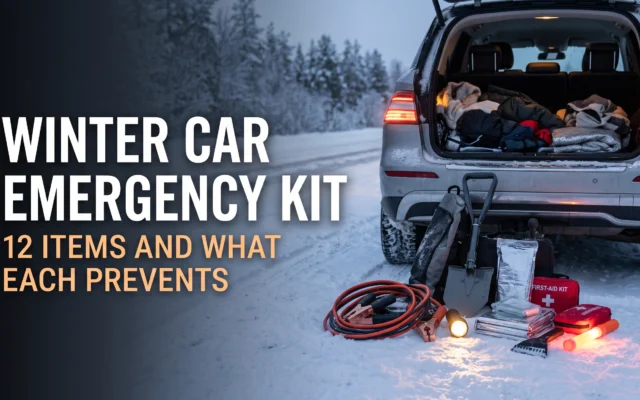
- You need a full list of what to carry in the car, which is in the winter car emergency kit: what to pack (2026)
How this guide was researched
Every number in this guide comes from battery maker documentation or from the AAA Automotive Research Center, and each one is linked where it appears.
Sources Cedar Buy used
- Load-test pass voltages, resting-voltage charge levels and charging limits from East Penn Manufacturing’s Battery Care & Maintenance sheet (form 0004, February 2026), read in October 2026.
- Cold cranking amps and cranking amps definitions from Optima Batteries; winter power loss and storage advice from Exide Technologies; freeze points from Discover Battery and Rolls Battery.
- Power loss at 32°F and 0°F from the AAA Automotive Research Center, a motoring club rather than a battery maker; its figures are averages.
- Specifications come from manufacturer documentation. Cedar Buy does not physically test products — see our editorial policy.
The short answer
Cold does not drain the charge out of a healthy battery overnight. It slows the chemistry that turns stored charge into current, so the battery can deliver less at the exact moment a cold engine asks for more. AAA’s Automotive Research Center reports a battery loses about 35% of its strength at 32°F and about 60% at 0°F, while starting can take up to twice the normal current.
The table adds the pass mark for a load test (a 15-second test at half the battery’s rated cold cranking amps). The mark falls as the battery gets colder, because the test allows for slower chemistry.
| Battery temperature | Starting power left | What the engine asks for | Load-test pass mark | What it means for you |
|---|---|---|---|---|
| 80°F (27°C) | 100%, the reference point | Normal starting current | 9.6 V (the 70°F-and-above row) | A weak battery can still start the car, so it hides its problems |
| 32°F (0°C) | About 65% | More, because oil is thicker and engine friction rises | 9.1 V (the 30°F row) | About a third of the battery’s power is gone before the engine even turns |
| 0°F (−18°C) | About 40% | Up to about twice the normal current | 8.5 V | An old or half-charged battery usually fails here |
Power figures are AAA averages for a new, fully charged battery, so an old or half-charged one has less. Pass marks come from East Penn’s load-test chart, rounded to the nearest 10°F as it instructs. The thicker-oil point is from Exide.
What happens to a battery below freezing
Below freezing, the chemical reaction inside a lead-acid battery slows down and the battery resists the flow of current more, so it hands less power to the starter motor. Exide says car batteries work best at about 80°F (27°C) and that a fully charged one has lost around a third of its starting power by 32°F (0°C).

The engine makes it worse. Cold oil is thick, so the starter pushes harder. Then the heater fan, defroster and headlights draw from the same battery on short trips that give the alternator (the engine-driven generator that recharges it) little time to catch up.
Freezing is the real danger, and it depends on charge. The liquid inside, called electrolyte, is acid and water, and it turns more watery as the battery runs down. Discover Battery’s freeze chart lists about −75°F for a full battery and −16°F at 25% charge. Rolls Battery warns that a fully discharged one can freeze just below 32°F, and freeze damage usually means replacement.

Cranking amps and why the rating drops
The cold cranking amps (CCA) number on your battery label is a test result from a new battery, and the power your battery can actually deliver drops below it as the battery ages and as it gets colder. Optima Batteries defines CCA as the current a new, fully charged battery delivers for 30 seconds at 0°F while staying at or above 7.2 volts.
You will also see cranking amps (CA), or marine cranking amps (MCA). It is the same test at 32°F, so the number is always higher than CCA. Match the CCA line, not the CA line, against the minimum in your owner’s manual. Optima notes that in most cases an extra 300 CCA is not necessary.
Testing a cold weather car battery before winter
Test your battery in October or November with two checks: a resting-voltage reading at home, then a load or conductance test at a shop. Voltage shows how charged it is; the load test shows whether it can still deliver current.
For the resting reading, park the car for a few hours with everything off, then put a digital voltmeter across the two terminals. East Penn’s chart puts a standard flooded battery at 100% charge at 12.6 V, 75% at 12.4 V, 50% at 12.2 V and 25% at 12.0 V. An AGM battery (absorbent glass mat, a sealed type common in cars with stop-start) reads higher: 12.8 V full and 12.6 V at 75%.

Below 12.4 V, charge it fully first; East Penn says a discharged battery cannot be load tested. Then apply half its CCA rating for 15 seconds and compare the voltage with this chart.
| Battery temperature | Pass mark |
|---|---|
| 70°F (21°C) or above | 9.6 V |
| 60°F (16°C) | 9.5 V |
| 50°F (10°C) | 9.4 V |
| 40°F (4°C) | 9.3 V |
| 30°F (−1°C) | 9.1 V |
| 20°F (−6°C) | 8.9 V |
| 10°F (−12°C) | 8.7 V |
| 0°F (−18°C) | 8.5 V |
Many shops use a handheld conductance tester instead, which estimates the result from a small signal. East Penn says it also fails on a discharged battery, so charge first. If a fully charged battery still fails, East Penn says to replace it.
Signs it will not survive another winter
The clearest sign is a battery that fails a load test after a full charge. Short of a test, watch for these four warnings, roughly in order of how much they should worry you.
It fails a load test after charging
A fully charged battery that drops below the pass mark above cannot be saved by more charging. Replace it before the first hard freeze.
It cranks slowly or clicks
A slow, labored crank means the battery is near its limit. Rapid clicking with no crank usually means it is past it. Get it tested that week.
It is three to five years old
AAA recommends a test past three to five years, and notes that summer heat does most of the wear while winter is when it shows.
Visible damage on the case
East Penn lists a cracked case, a leaking seal, damaged terminals and corrosion as checks before any test. A cracked or leaking case means replacement, whatever the voltage says.
Jump starter as a backup
A portable jump starter (a small battery pack with clamps) is worth keeping in the car all winter, because it gets you going without waiting for a second vehicle. Treat it as a way home, not a fix. AAA advises getting the battery checked after a jump, since a battery that needed one may be on its way out.

Compare jump starters on a cranking amps or cold cranking amps figure, which comes from a test at a set temperature and duration. A big “peak amps” number states neither, so ignore it.
Never jump-start or charge a frozen battery. East Penn warns it can explode; bring it indoors to warm up first. Keep the pack charged and in the cabin, not the trunk. For the rest of what belongs in the car, see the winter car emergency kit: what to pack (2026).
Storage for a car you will not drive
A car parked for the winter needs its battery kept fully charged, because a battery that slowly runs down is the one that freezes. Modern cars draw a little power even when locked, for alarms, keyless entry and computer memory, as Exide points out.
Use a smart battery maintainer, a small charger that tops the battery up and holds it at full without overcharging. Without an outlet, Exide advises recharging a stored car’s battery at least every four to six weeks. Disconnecting the negative cable stops the drain, but it can reset the radio and clock.

For an AGM battery, use a charger with an AGM setting: East Penn warns that more than 15.4 V, even once, can shorten its life. A garage helps too, because a warmer battery has more power.
Key terms, explained
Battery labels and testers use three terms that sound alike but measure different things.
Plain-language definitions
- Cold cranking amps (CCA)
- The current a new, fully charged 12-volt battery delivers for 30 seconds at 0°F while staying at or above 7.2 V.
- Resting voltage
- Terminal voltage after the car has sat with everything off. On a flooded battery, 12.6 V is full and 12.4 V is about 75%.
- Load test
- A 15-second draw at half the CCA rating. The pass mark runs from 9.6 V at 70°F down to 8.5 V at 0°F.
Mistakes that cost people money
The most expensive mistake is replacing a battery that only needed charging, or keeping one that needed replacing, because nobody charged it before testing it.
- Testing a half-charged batteryBelow 12.4 V, almost any battery fails. Charge it, then test, so you know whether the battery or the charge was the problem.
- Comparing CA against CCAA battery that lists 800 CA is not an 800 CCA battery. Check the CCA line against your owner’s manual.
- Jumping a frozen batteryIt can explode. Warm it indoors, then charge it, and replace it if the case has cracked or leaked.
- Leaving a stored car untouched until springSmall constant draws flatten the battery over months, and a flat battery freezes far sooner than a full one.
Frequently asked questions
At what temperature does a car battery stop working?
There is no single cutoff. The AAA Automotive Research Center says a fully charged battery keeps only about 40% of its starting power at 0°F, while the engine can need up to twice the current. A healthy, charged battery usually still starts the car at 0°F. An old or half-charged one often does not.
Can a car battery freeze?
Yes, but only when it is low on charge. Discover Battery lists a fully charged battery freezing at about −75°F, while Rolls Battery warns that a fully discharged one can freeze just below 32°F. Freezing can crack the case and usually means a new battery, so keep it fully charged, especially in a car that sits.
What voltage should my car battery read in winter?
A standard flooded battery should rest at about 12.6 V when fully charged, measured after the car has sat for a few hours with everything off. East Penn rates 12.4 V as about 75% charge, and anything lower needs charging before winter. An AGM battery reads higher, about 12.8 V when full, so check which type you have first.
How often should I test my car battery?
Test it every fall once it is three years old, since AAA recommends testing once a battery passes three to five years. Before that, test it whenever it cranks slowly or has needed a jump. Charge it fully first, or the result will not tell you much.
What to do before the first freeze
Cedar Buy’s advice is simple: this month, read your battery’s resting voltage, charge it to full, and get it load tested.
If it passes, keep a charged jump starter in the cabin as insurance. If it fails after a full charge, or it is past five years and cranking slowly, replace it now while you choose the day. If the car will sit for the season, put it on a maintainer before you walk away.





Article engagement
Comments (0)
No comments yet. Be the first to share what you think.
Sign in to join the conversation.