

Getting Your Truck Ready for Winter

October 16, 2026 · 14 min read

The first hard frost always seems to land on the morning you need the truck most. A dead battery, a bed full of slush and a windshield you cannot clear turn a 10-minute drive into a cold hour. This truck winter prep checklist spreads the work across September to December, gives every job a deadline, and covers the parts a car checklist skips: the bed, the cover and the weight you carry back there.
Updated — dates set for winter 2026
The short answer
A truck winter prep checklist comes down to five jobs done before the first 32°F night: test a battery older than 3 years, set tires to the door-jamb pressure, switch to winter washer fluid and new wipers, pack a roadside kit, and keep any bed weight over the rear axle and inside your payload limit.
Who this guide is for
This guide is for you if you drive a half-ton or midsize pickup through a winter with freezing nights, and you do your own basic checks. You do not need tools beyond a tire gauge and a flashlight.
This is for you if
- Your pickup sits outside overnight when lows drop below 32°F
- You drive with an empty bed most of the winter and the rear end feels loose on snow
- You have a tonneau cover (a lid over the bed) and are not sure how it copes with snow
Look elsewhere if
- You run a commercial semi or heavy-duty fleet truck with air brakes. That is a different checklist
- You want the full kit list for any vehicle: see winter car emergency kit: what to pack (2026)
How this guide was researched
This guide is built from federal safety guidance, a federal vehicle standard and state transportation rules, not from hands-on testing.
How this guide was researched
- Cedar Buy read NHTSA’s winter driving guidance, Federal Motor Vehicle Safety Standard No. 110 (the rule behind the door-jamb loading placard) and Washington State DOT’s studded-tire rules in October 2026.
- Battery figures come from AAA statements, as reported in news coverage. Winter-tire temperature and 3PMSF guidance come from tire retailers’ published technical pages, named where each claim appears.
- Deadlines are tied to temperatures and fixed dates, not to a region, because the first freeze arrives in different weeks across the US.
- Cedar Buy does not physically test products — see our editorial policy.
Truck winter prep checklist, month by month
Start in September with the battery, finish the tires and bed in November, and use December to keep what you set up. Each row below has a deadline you can put in your calendar. The deadline column matters most: a job done a week late is a job done in the cold.
| Month | Task | Deadline | Why it cannot wait |
|---|---|---|---|
| September | Get the battery load-tested if it is 3 or more years old | Before the first night below 32°F | AAA puts the strength loss at about 35% at 32°F and 60% at 0°F |
| September | Book a winter-tire fitting, or check tread on the tires you have | September 30 | You want the slot before you need the tires, not after |
| October | Run your VIN through NHTSA’s recall look-up | October 15 | A recall repair is free, and you want it done before the roads turn |
| October | Fill with winter washer fluid, fit new wiper blades, check coolant | Before the first forecast freeze | Summer fluid can freeze in the lines and on the glass |
| October | Walk around with the lights on: headlights, brake lights, signals, trailer plug | October 31 | Clocks go back on Sunday, November 1, 2026, so more of your driving is in the dark |
| November | Fit winter tires, or reset tire pressure to the door-jamb number | When daily highs stay below 45°F | Studded tires are legal in Washington only from November 1 |
| November | Clear the bed and cover drains, load ballast over the rear axle, strap it down | Before the first snow in the forecast | An empty bed is the lightest corner of the truck on ice |
| November | Pack the roadside kit behind the seat | November 25, before Thanksgiving travel | The longest drives of the year start the next day |
| December | Check tire pressure with the tires cold | The first of every month | Pressure keeps falling as the nights get colder |
| December | Keep the fuel tank close to full | All winter | If you get stuck, fuel is your heat |
What the table does not show
Studded-tire dates are set by each state. Washington and Oregon both end the season on March 31, but other states use their own windows, so check your state DOT before you fit studs.
Bed cover and cargo in snow
Brush snow off the bed and cover after every storm, and before you open the cover. Snow adds weight you did not plan for, and it slides into the bed the moment you lift the lid. A tonneau cover is a hard or soft lid that closes over the bed; check its manual for a snow-load rating, and if it gives none, treat the cover as not built to carry snow.
Snow is heavier than it looks. Fresh snow typically weighs 5 to 12 pounds per cubic foot and wet snow up to 50, according to Pima County Regional Flood Control District. On a bed about 6.5 feet long and 5 feet wide, 6 inches of fresh snow comes to roughly 80 to 195 pounds. Wet snow can push that past 500 pounds.
Before the first storm, clear the drain holes in the bed corners and the drain tubes on the cover. Blocked drains hold water that freezes overnight and locks the latches. Leave nothing loose in an open bed: snow and ice from it blow straight into the windshield of the driver behind you.
Battery and starting
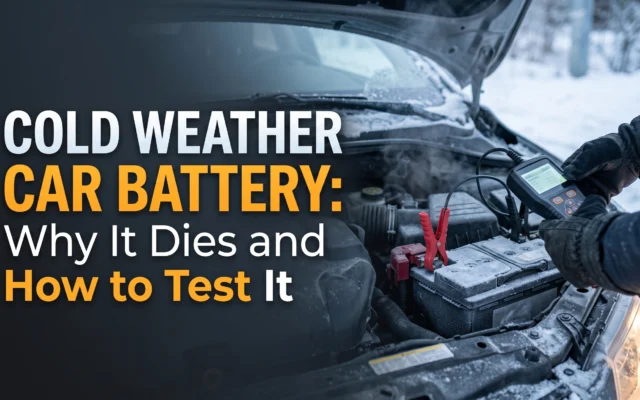
Get the battery tested before the first 32°F night if it is 3 or more years old. That is the age at which AAA advises a test, and it is the cheapest job on this list. Cold slows the chemical reaction inside a battery, so it has less to give at the exact moment the engine needs more.
The numbers are large. AAA puts the loss at about 35% of a battery’s strength at 32°F and about 60% at 0°F, as reported by CBS Philadelphia. NHTSA also notes that gasoline and diesel engines take more battery power to start in cold weather. For the full story of why, read how cold weather kills car batteries.
Ask for a load test, not just a voltage reading. A voltage check shows whether the battery is charged. A load test shows whether it can still deliver power under strain, which is what a cold start demands. If you own a diesel, read the block-heater section of your owner’s manual now, before you need it.
Traction and weight in the bed
Tires do most of the work, and weight in the bed does the rest. A pickup carries its engine up front, so with an empty bed the rear tires press down lightly and spin first. Good winter tires fix more of that than any sandbag.
Look for the three-peak mountain snowflake symbol (3PMSF) on the sidewall. It means the tire passed a standard snow-traction test. Tire Rack notes that 3PMSF all-terrain tires still fall short of dedicated winter tires in harsh conditions. Winter rubber starts to pay off once temperatures stay below about 45°F, where America’s Tire says all-season compounds stiffen and lose grip.
Check pressure with the tires cold, at least monthly, and fill to the number on the door-jamb label. Never fill to the figure on the tire itself; NHTSA points out that number is the tire’s maximum, not your truck’s setting. Pressure typically drops about 1 PSI for every 10°F the air cools, a rule of thumb that follows from how gas shrinks in the cold.
If you add ballast (dead weight carried for traction), put it over or just ahead of the rear axle and strap it down. Weight behind the axle, at the tailgate, lifts load off the front tires you steer and brake with. Aftermarket guidance typically suggests 200 to 400 pounds for a rear-wheel-drive pickup, as AmericanTrucks puts it; truck makers do not publish a figure.
Ballast counts against your payload. Every pickup rated at 10,000 lb GVWR or less carries a Tire and Loading Information placard on the driver’s door pillar. Under FMVSS No. 110, it states the most that occupants and cargo may weigh together. Add up your passengers, your gear and the ballast, and keep the total under that line.

Visibility: wipers, lights, cameras
Fill the washer tank with winter fluid, fit fresh blades and check every light before the first freeze. NHTSA warns you can go through a lot of washer fluid in a single snowstorm, so carry a spare jug. Many winter jugs are rated to −20°F; read the rating and pick one colder than your coldest night.
Test the defroster, then walk around the truck with the lights on: headlights, brake lights, turn signals, hazards and the trailer plug if you tow. A pickup’s tall tailgate and rear camera collect road salt fast. Wipe the camera lens and tail lights at every fuel stop.
Clear the whole truck, not a porthole. The Minnesota Department of Public Safety notes that snow left on the hood blows into the vents and fogs the glass, and snow on the roof slides over the rear window. On a pickup, the cab roof is high, so keep a long-handled brush in the truck.
Roadside kit for a truck
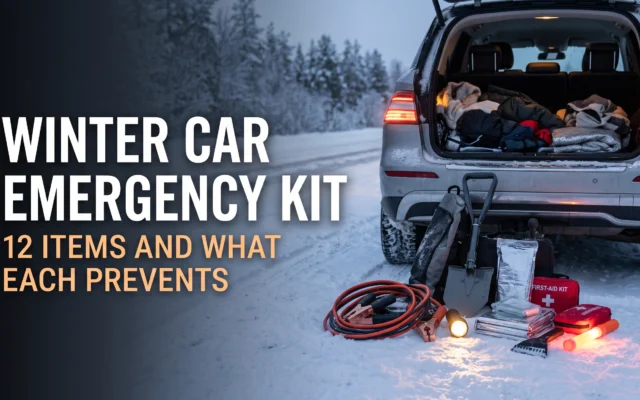
Pack a kit that gets you unstuck and keeps you warm until help arrives. NHTSA’s list covers a snow shovel, broom and ice scraper, sand or kitty litter, jumper cables, a flashlight, flares or markers, a first aid kit, blankets, and a phone charger with water, food and any medicine you need.
A pickup adds two items. Keep tow straps rated for your truck’s weight and a pair of work gloves. Store the kit behind the seat, not in the bed, because a bed box can freeze shut or end up under a snowdrift.
If you get stuck, stay with the truck, clear snow from the tailpipe, and run the engine only long enough to stay warm. NHTSA gives that advice to prevent carbon monoxide poisoning. The full list is in winter car emergency kit: what to pack (2026).
The autumn check that takes an hour
If you only have one Saturday, do these four checks in this order. Together they take about an hour with a tire gauge, a flashlight and a jug of washer fluid, plus the drive to a shop for the battery test.
Battery: age and a load test
Find the date sticker on the battery. If it is 3 or more years old, get a load test at a parts store or shop. A weak battery that passes in October can still fail at 0°F.
Tires: pressure, tread and the spare
Set all four to the door-jamb number with the tires cold. NHTSA’s minimum tread is 2/32 inch, which leaves almost nothing to bite into snow. Check the spare too; on most pickups it hangs under the bed, out of sight.
Fluids, wipers and lights
Top up winter washer fluid and coolant, run the wipers on wet glass, and replace any blade that streaks. Then walk around with every light switched on.
Ignore the max PSI on the sidewall
The big number molded into the tire is its maximum, not your setting. Filling to it makes the tire hard and cuts grip on snow. The only number that matters is on the door-jamb label.
Key terms, explained
These terms show up on tires, batteries and door labels, and each one is easy to misread.
Plain-language definitions
- Payload
- Payload is the most weight a truck may carry in people and cargo combined, in pounds. It is printed on the Tire and Loading Information placard on the driver’s door pillar, and ballast counts toward it.
- Three-peak mountain snowflake (3PMSF)
- 3PMSF is a sidewall symbol showing a tire passed a standard snow-traction test. It is not the same as M+S (mud and snow), which describes tread shape and promises no tested snow grip.
- Ballast
- Ballast is dead weight, such as sandbags, carried in the bed to press the rear tires down for grip. It works best over or just ahead of the rear axle and must be strapped down.
- Load test
- A load test draws heavy current from a battery to see if it holds voltage under strain. It tells you far more about cold-start readiness than a simple voltage reading.
Mistakes that cost people money
The most expensive mistake is skipping the battery test, because a no-start in the cold often means a tow as well as a new battery.
- Waiting for the first no-startA battery that is 3 or more years old should be tested before the first freeze, not after it leaves you stranded.
- Loading weight at the tailgateWeight behind the rear axle lightens the front end, so steering and braking get worse. Keep it over or just ahead of the axle.
- Treating M+S tires as winter tiresM+S only describes tread shape. Look for the 3PMSF symbol, and know that dedicated winter tires still outgrip 3PMSF all-terrains.
- Running summer washer fluid into NovemberIt can freeze in the lines and on the glass. Swap to winter fluid before the first freeze and run the old fluid out.
- Opening a snow-covered tonneau coverThe snow drops into the bed and onto your cargo, and frozen latches can bend if forced. Brush the cover first.
Frequently asked questions
How much weight should I put in my truck bed for winter?
Aftermarket guidance typically suggests 200 to 400 pounds for a rear-wheel-drive pickup, placed over or just ahead of the rear axle and strapped down. Truck makers do not publish a ballast figure. Whatever you add counts against the payload on your door-jamb placard, along with passengers and gear. Good winter tires do more for grip than extra weight does.
When should I put winter tires on my truck?
Fit winter tires once daily highs stay below about 45°F, which is where all-season rubber starts to stiffen and lose grip. Book the fitting in September so you are not waiting for a slot. If you use studded tires, follow your state’s dates; Washington allows them only from November 1 to March 31.
Does a 4×4 truck still need winter tires?
Yes. Four-wheel drive helps you get moving because it sends power to all four tires, but it does nothing extra for stopping or steering on ice. Those depend on the grip of the tires themselves. A 4×4 on worn all-season tires can still slide through a corner or past a stop sign.
Can snow damage a tonneau cover?
It can if the cover is not rated for snow load. Fresh snow typically weighs 5 to 12 pounds per cubic foot and wet snow far more, so a full bed of it is heavy. Check your cover’s manual for a load rating, brush it off after each storm, and keep the drain tubes clear so water cannot freeze the latches.
Why does my tire pressure light come on when it gets cold?
Cold air takes up less space, so tire pressure typically drops about 1 PSI for every 10°F the temperature falls. A warm October afternoon to a frosty morning can drop several PSI overnight. Refill to the door-jamb pressure with the tires cold, and check again monthly through winter.
What to do this weekend
Start with the battery: if it is 3 or more years old, get it load-tested this week, before the first 32°F night.
Then book your tire fitting, swap to winter washer fluid, and put the November jobs from the checklist above in your calendar with their deadlines. Cedar Buy’s view is simple: the work is the same every year, and the only thing that changes the outcome is doing it before the cold arrives, not after.


Article engagement
Comments (0)
No comments yet. Be the first to share what you think.
Sign in to join the conversation.